

After comparing multiple options—from performance and price to exterior design—you've finally chosen your ideal new energy vehicle. Just as you're about to make the purchase, you suddenly come across news that this car model has a "battery defect that could easily cause thermal runaway and fires." At this point, would you still choose to buy it?
I believe most people's answer would be "no." After all, for new energy vehicles, the battery is like the "heart" of the car. Its quality directly impacts the overall safety and reliability of the vehicle, and can even have "veto power." Survey data from the China Passenger Car Association also shows that vehicle reliability remains a core decision-making indicator for consumers.

Image generated by AI
Recently, media reported that a certain automaker announced a recall of some models in countries and regions including the United States, Canada, the United Kingdom, and South Africa. The reason was that the automaker, through its internal quality tracking system, discovered potential design flaws in the battery packs of some vehicles, posing a risk of thermal runaway.
Although the automaker proactively identified the problem and initiated a recall, this incident still sparked public doubt about its products and supply chain system. A defective battery pack is like a "time bomb" hidden in the car, capable of triggering safety issues at any moment. It not only affects the safety experience of existing car owners but can also directly deter potential consumers.
In fact, battery safety has never been the responsibility of a single link. It runs through the entire lifecycle, from cell selection, battery pack design, and vehicle integration, to post-production monitoring and maintenance. It is a comprehensive test of an enterprise's supply chain management and risk prediction capabilities.
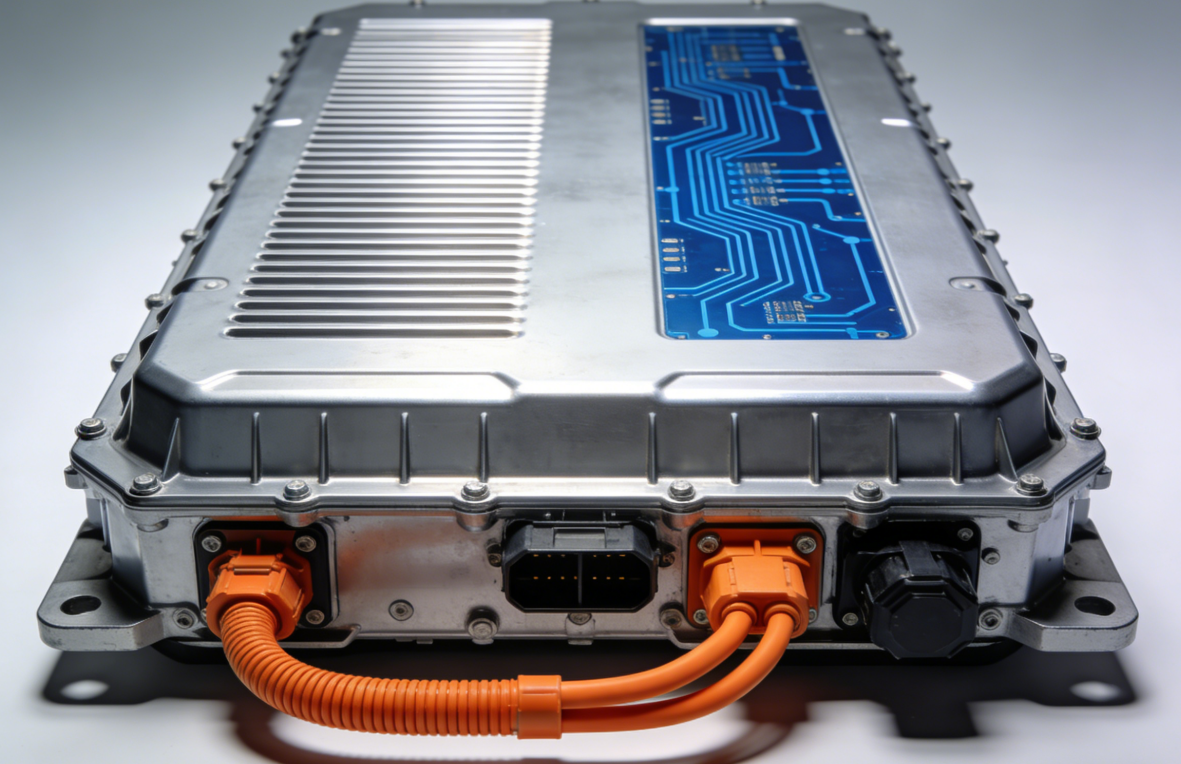
Image generated by AI
For enterprises, ensuring product quality and safety requires systematically solving common pain points in quality management—such as "short lifespan, failure soon after use," "unclear responsibilities, low collaboration efficiency," "data not utilized well, decisions rely on experience," "difficult problem traceability, high recurrence rate," "loose supplier management, large fluctuations in incoming material quality"—and building a full lifecycle quality management system characterized by "end-to-end process integration, data-driven decision-making, and intelligent collaborative response." This reduces internal rework, lowers external recalls, and achieves a closed quality loop from R&D to after-sales:
R&D Stage: Implement the principle that "quality is designed in, not inspected in." Use tools like Design Failure Mode and Effects Analysis (DFMEA) during the design phase to proactively identify potential risks and failure modes in the design and formulate preventive measures.
Reliability Control Stage: Establish a reliability control system spanning from design verification to decommissioning analysis. Reliability analysis modules can perform accelerated life simulation and failure risk prediction for key battery components. Combined with real-time data collection during production, they can automatically identify the impact of process fluctuations on battery reliability and trigger alerts and root cause analysis. When reliability anomalies occur during the battery's usage phase, the software can trace full-link data, locate potential hidden dangers in design, production, or the supply chain, and drive cross-departmental collaborative optimization, thereby continuously improving battery reliability performance and reducing safety accident risks and after-sales costs for the enterprise.
Production Stage: Use SPC and PFMEA to make quality management proactive with prevention and early warnings. Use CP management to connect various departments for efficient collaboration. Problems encountered with products during the process can be quickly located and their causes identified, guiding timely improvements in the supply chain, R&D, and processes, achieving continuous quality improvement.
Supply Chain Stage: Strengthen proactive quality management for suppliers, controlling product quality from the source of raw material and component supply. Establish a digital quality management system for the supply chain, enhancing its agility and resilience while also reducing costs and increasing efficiency.
After-sales Stage: Achieve end-to-end deep collaboration to ensure every quality issue can be tracked, analyzed, and resolved, and provide preventive measures for similar future situations. Ensure clear problem ownership, a closed-loop handling process, and continuous improvement.
The key lies in the "Reliability Control Stage," as it directly determines the lasting safety of the battery. In this regard, Xiwitab can provide comprehensive analytical support services. Here is a typical example:
An automaker, during the battery pack validation for an early model, discovered significant fluctuations in the cycle life of different batches of cells. After 3000 cycles, the failure rate reached as high as 18%, failing to meet the vehicle's 10-year/200,000-km warranty commitment.
1.Data Collection and Fitting Analysis
Shape parameter β ≈ 30.63, indicating the cells are in the wear-out failure phase, with failures mainly caused by cumulative factors like electrolyte aging and electrode wear.
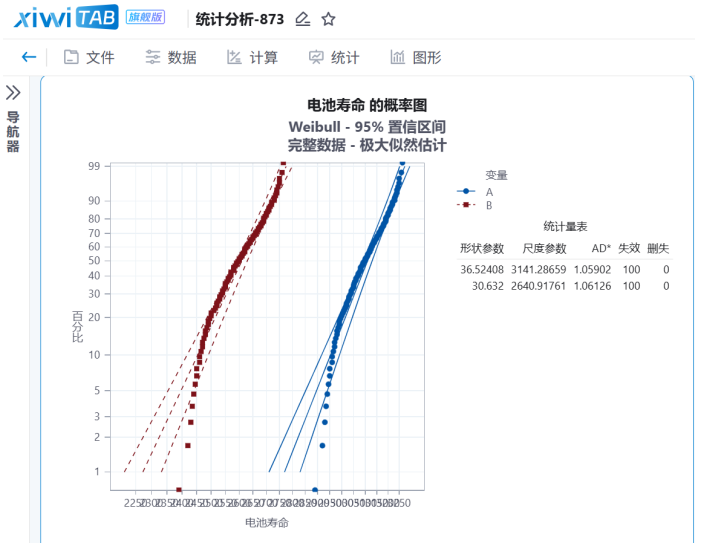
Scale parameter η ≈ 2640 cycles, meaning 63.2% of cells are expected to fail by 2640 cycles, significantly short of the 3000-cycle target.
AD* value = 1.06, much less than 2, validating the effectiveness of the Weibull distribution fit.
Import complete cycle life data for 200 cells (no censored data) into Xiwitab. The software automatically fits a Weibull distribution and outputs key parameters:
2.Root Cause Identification
Using Xiwitab's grouping comparison function to analyze cells split by electrode material supplier, it was found that cells from Supplier A had η ≈ 3141 cycles, while cells from Supplier B had η ≈ 2640 cycles, a 19% difference in lifespan between groups.
Combining this with the difference in β values (Supplier A β ≈ 36.52, Supplier B β ≈ 30.63) further pinpointed the issue to insufficient coating uniformity in Supplier B's electrodes, which accelerated later-stage aging.
3.Design Optimization and Validation
The new batch of cells achieved η ≈ 3000 cycles, meeting the design target.
The failure rate after 3000 cycles dropped to below 5%, significantly reducing the warranty risk for the entire vehicle battery pack.
After prompting Supplier B to optimize their coating process, validation using Xiwitab showed:
Interpretation Notes for Key Parameters:
Shape Parameter (β): This parameter represents the slope of the Weibull distribution. It determines how the failure rate changes over time. If β > 1, the failure rate increases over time, indicating the wear-out failure phase. In simpler terms, when this value is >1, it means the failure rate and time change in the same direction. If β = 1, the failure rate is constant over time. If β < 1, the failure rate decreases over time.
Scale Parameter (η): This parameter represents the life at which 63.2% of the population is expected to have failed. The larger this value, the more robust the product. Simply put, it's the life value (number of use cycles) when 63.2% of the products have failed.
AD Value:* This is a goodness-of-fit statistic used to assess how well the data fits the chosen distribution. Generally, if AD* < 2, the data is considered to fit the distribution very well. In simpler terms, if this value is >= 2, it could mean the distribution fitting result might be incorrect. If this value is < 2, it indicates that the correct distribution form has been identified for fitting.
As quality management guru Philip Crosby once said, "Quality is free. It's not a gift, but it is free. What costs money are the unquality things — all the actions that involve not doing it right the first time." Consumer trust in a brand is like carefully cherished colored glaze; it takes years to build but can be destroyed by a single safety incident. Enterprises that truly achieve comprehensive quality management with no blind spots and integrate a preventive system into their entire value chain will be the ones that solidly build the cornerstone of trust, constructing a strong moat for their brand in the fierce market competition.